|
Trip Summary:
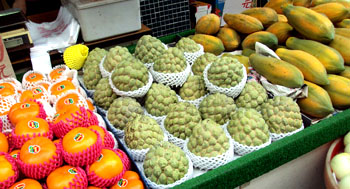
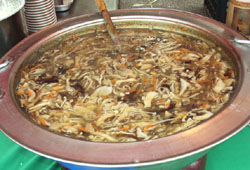
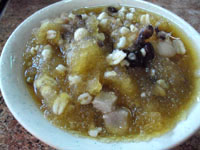
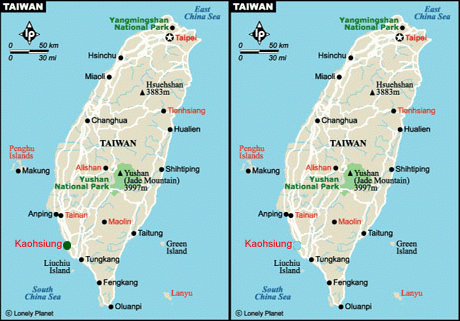
However, I forgot to take photos of the delicious food that my sister-in-law, Ruei-Hsia, cooked at home; nor any of the delicious food that we took out from eateries/restaurants to eat at home with mom. So these pictures represent the food I had (or saw) while outside of my mother's house, except for the Japanese melon. Kaohsiung is a port city located in southwestern Taiwan, and is the second largest city in Taiwan. (The blinking dot on the map to the right.)
Transportation:
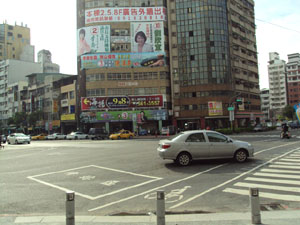
The City: Kaohsiung is an industrial city of manufacturing, refining, shipbuilding, and other light and heavy industries. As a result, a high percentage of its 1.5 million people are blue color workers, that partly explains why the city's brand new metro system is almost deserted - people prefer riding motorcycles (faster and cheaper) than taking metro or city buses. Public transportation A ride on a city bus was NT12 (USD$ 0.40), and a ride on the sleek metro system starts from NT20 (fare increases according to distance). But the metro stations and metro cars were almost deserted. After one ride I did not feel comfortable enough to ride again. (Click links to see photo.) I took city bus quite often, it came frequently, and always with plenty of
empty seats. I think the city government is footing a big budget to provide a
network of public transportations that are not fully utilized by its residents.
Once I saw a bus came and went with no one inside but the driver.
I also borrowed a bicycle from brother Yong to ride several short distances from Mother's house. The last day I rented a bike from Hotel Kingdom (NT20 per hour) to run a few errands. Biking is certainly faster than walking or taking bus, and also enabled me to zip from point A to point B quickly. I felt a lot of freedom on a bike.
Breakfast at Tien-Ji's photo link
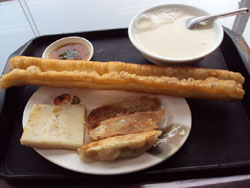
Therefore, instead of a very full buffet breakfast at the hotel every morning, I went out to seek good eats near the hotel. Behind the hotel is a popular breakfast place called Tien-Ji, which has been serving breakfast for four decades. One of my favorites at Tien-Ji is pan-fried dumpling (pot stickers), bite into it and the flavorful juice just filled my mouth. Tien-Ji is a self-serve place, it took me two days to figure out the system. You'd pick what you want and place on a plate or put in a bag (if take away), make/mix your own dipping sauce, then line up to buy hot or cold soy milk and pay. Then go upstairs to find a table and seat.
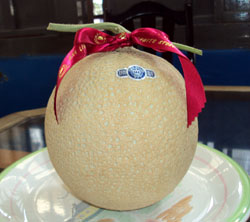
Sometimes I had western pastries with coffee for breakfast. Twice I bought pastries from a bakery with a French name (Le Petit Prince), and once I bought pastries from a bakery with a Japanese name. They all looked inviting and tasted delicious. (I forgot to take photo.) Visitors and Japanese melon photo link One day, Mr. and Mrs. Yuen, the owners of a high end fruit company called May Lin Fruits in Taipei, and good friends of my oldest brother Chester, came to visit mom. May Lin Fruit imports many high end fruits from Japan. As customary in Taiwan, you bring an expensive gift to show respect to the person you are visiting, so they brought a pair of Japanese melon imported from Shizouka (静岡), Japan.
Our tour guide at that time took us to a fruit store in Ginza and told us to go inside to take a look at the fruits and their prices. A melon which looked like the picture to the right was ranging from USD$60 to $120, depending on which farm it came from. These expensive melons are grown in green houses, and each plant was pruned to bear just one fruit at a time, that was why they are so expensive and so sweet and juicy. However, these prized melons are gifts for special occasions such as birthday, anniversary, promotion, graduations etc, they are too expensive for daily consumption. For daily consumption a resident in Japan would walk into a supermarket and buy an ordinary melon for much less money, which may be imported from southern Europe or south America. 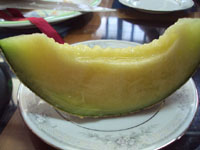
Suffice to say I have only seen the outside of these expensive melons, never the inside. So a few days later sister-in-law Ruei-Shia decided to cut up one for everyone to share. (The other one was to be saved till sister-in-law Toshiko arrived in Kaohsiung from San Francisco, a few days after I left Taiwan.) I had expected the inside to be in orange color like cantaloupe, but it was in pale yellow, a bit like Athenian melon, yet extremely juicy and sweet. (See photo links for larger pictures.)
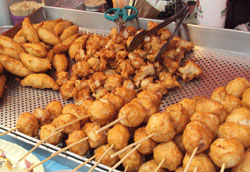
I walked through the whole length of the vendors, ate some, bought some dry goods. I was not brave enough to try more varieties, but took photos.
Liou-Ho night market is now called Liou-Ho Tourist Night Market, because it is frequented by bus loads of tourists from mainland China. As a result, there is a new night market called Ruei-Fon Night Market (瑞豐夜市) catering to local clienteles. However, Ruei-Fon Night Market is closed two nights a week, therefore I missed an opportunity to visit it. 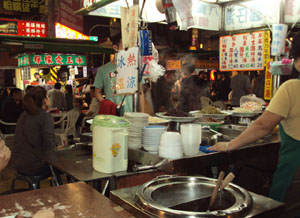
Hope you enjoyed viewing the food pictures as much as I had enjoyed them. |
 In November I flew to Kaohsiung to visit my mother for eight days. I
took these pictures to record the good eats I had in Kaohsiung. After living
in USA for four decades, I missed Taiwanese food from small eateries more
than food from big restaurants.
In November I flew to Kaohsiung to visit my mother for eight days. I
took these pictures to record the good eats I had in Kaohsiung. After living
in USA for four decades, I missed Taiwanese food from small eateries more
than food from big restaurants.